• Explore Categories
    • Living Planet
    • People & Patterns
    • Natural Wonders
    • Odds & Ends
    • Behind the Map
Subscribe
Search Form
No Result
View More Search Results

Mapping What’s in Orbit and How it Got There

by Joshua Stevens
Submitted Map
March 17, 2025
Odds & Ends

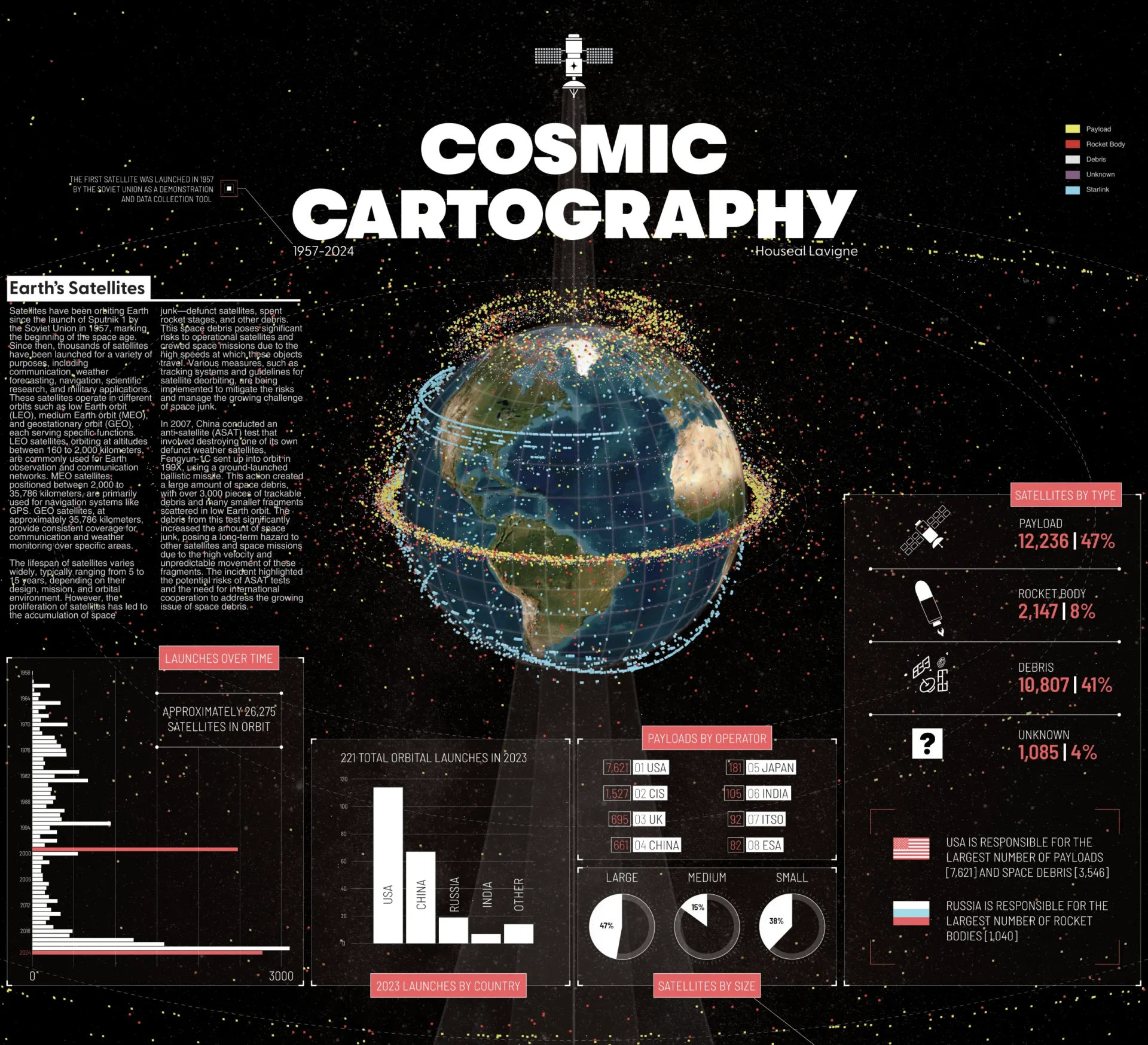
Earth has a single natural satellite—our Moon. But tens of thousands of artificial satellites have been sent into orbit. And most of them remain, revolving around Earth at various altitudes.

Nearly half of the artificial satellites in orbit carry a payload. Often, these are in the form of sensors for observation, systems like GPS, and other scientific instruments. A small portion, about eight  percent, consists of the rocket bodies used to propel such instruments into space. But more than 40 percent of the satellites in Earth’s orbit are space debris: defunct  instruments and other materials that have been discarded and left in an orbital graveyard. Most satellites and debris originate from the United States. This map submission comes from Devin Lavigne, Jack Lavigne, and Rob Stauder of Houseal Lavigne.

Tens of thousands of satellites and other instruments remain in Earth's orbit.
Replete with data and informative charts, the graphic details the number, origin, and timeline of satellites in orbit between 1958– 2024. (Source: Devin Lavigne, Jack Lavigne, and Rob Stauder)

Data for this graphic comes from multiple sources, including those from the National Aeronautics and Space Administration (NASA) and TheSpaceReport.org.

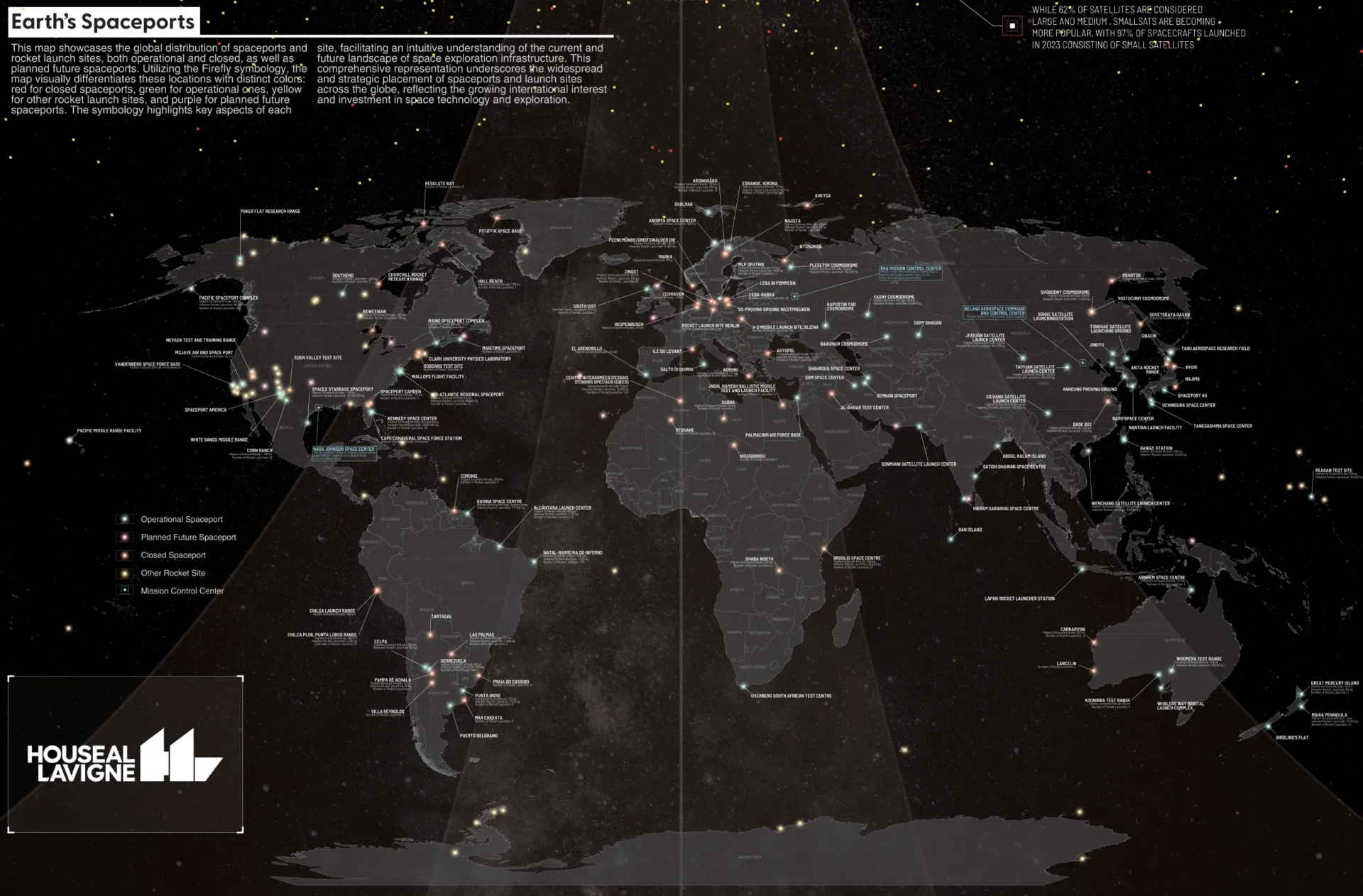
The complete infographic also includes a map of Earth’s spaceports and rocket launch sites. It indicates the sites that are operational (green), closed (red), sites planned for future launches (purple), and others (yellow). Launchpads and other sites are present on every continent, and numerous sites are located in the oceans. Additional maps and graphics display information about successful missions to the Moon by country, and which nations have signed the Moon Treaty.

Rockets have been launched from every continent on Earth.
Earth’s surface is peppered with spaceports and launch sites. (Source: Devin Lavigne, Jack Lavigne, and Rob Stauder)

Together, these graphics and maps showcase an elegant and cohesive overview of spacebound ambitions. It also underscores the necessary and grim reality that anything we send into space is likely to remain there, at least for some time. What goes up does not always come down.
Cosmic Cartography

Mapping What's in Space and How it Got There
Explore the Full Infographic

More to Explore

  • Learn how NASA uses a constellation of satellites to track Earth’s vital signs.
  • See who is in space right now.
  • Learn more about space debris from NASA’s Orbital Debris Program Office.

About This Map

Title
Cosmic Cartography
Creator
Devin Lavigne, Jack Lavigne, and Rob Stauder of Houseal Lavigne
Submitted Map

This map was contributed through the Maps.com submission program. If you’d like your map to be featured, submit it for consideration.

Tags
Space Submitted Map
Share This Article

Keep Exploring

Map of Earth showing satellites orbiting the planet.

Tracking Earth’s Vital Signs

October 24, 2024
Living Planet
Interactive NASA Satellites
The US faces many natural disasters, the type of which varies by location.

Back to the Map: The United States of Natural Disasters

July 21, 2025
Behind the Map
Back to the Map Climate Change Disasters
Photo of Austrian Alps.

Back to the Map: Avalanche Risk in Dachstein Area

June 10, 2025
Behind the Map
Back to the Map Snow
View More Maps
Next Post
Government sensors track incoming meteors.

Great Balls of Fire: Mapping Meteors

March 17, 2025 Natural Wonders

Maps.com
Explore Today.
Create Tomorrow.
  • About Maps.com
  • Submit a Map
  • Contact
  • Legal
  • Privacy
  • Media Use
  • Manage Cookies
  • Do Not Share My Personal Information
  • Legal
  • Privacy
  • Media Use
  • Manage Cookies
  • Do Not Share My Personal Information
  • Categories
    • Living Planet
    • People & Patterns
    • Natural Wonders
    • Odds & Ends
    • Behind the Map
  • About
  • Submit Map
  • Contact Us
Subscribe

  • Legal
  • Privacy
  • Media Use
  • Manage Cookies
  • Do Not Share My Personal Information

Add New Playlist

  • Categories
    • Living Planet
    • People & Patterns
    • Natural Wonders
    • Odds & Ends
    • Behind the Map
  • About
  • Submit Map
  • Contact Us
Subscribe

  • Legal
  • Privacy
  • Media Use
  • Manage Cookies
  • Do Not Share My Personal Information

Thank you!

We have received your request and will send updates about Maps.com to your email:

Continue reading article

Sign Up For Updates

Skip to content