• Explore Categories
    • Living Planet
    • People & Patterns
    • Natural Wonders
    • Odds & Ends
    • Behind the Map
Subscribe
Search Form
No Result
View More Search Results

Track the Epic Journeys of 15 Whale Sharks

by Robby Deming
March 6, 2025
Living Planet

It takes a lot of food (about 45 pounds per day) to sustain a whale shark. The sharks, the largest known fish on Earth, can grow between 18 and 32 feet long. As filter feeders that subsist on krill and plankton, whale sharks must swim vast distances to sate their appetites. Over the course of their lives (which can last more than 100 years), whale sharks travel distances that can exceed the circumference of Earth. 

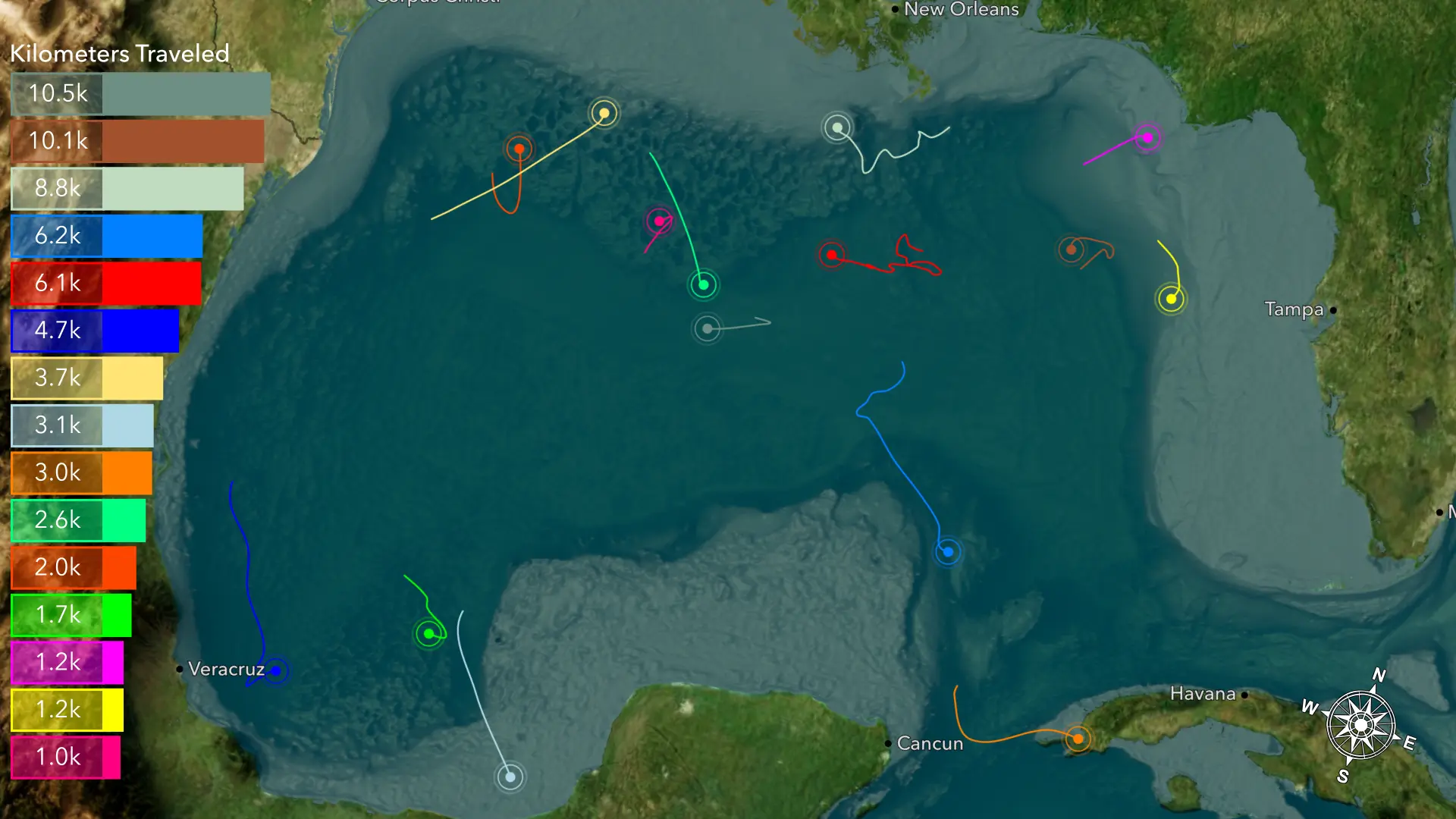
This animated map charts the journeys of 15 different whale sharks in the Gulf of Mexico. It’s based on observations from Movebank that span between 2009 and 2015.

Map of Gulf of Mexico showing tracks of 15 whale sharks.
Whale sharks range across the gulf over the course of their observed journeys. (Source: Maps.com)

The video begins with an overview of whale sharks and shows them swimming and feeding. A bathymetric map of the Gulf of Mexico (recently renamed in the US as the Gulf of America) then appears. It centers on feeding grounds off the southern coast of Louisiana where the sharks were first tagged. As the video plays, 15 animated colored tracks representing different whale sharks begin to appear. Some of the sharks meander around the feeding grounds while others head east and south. 

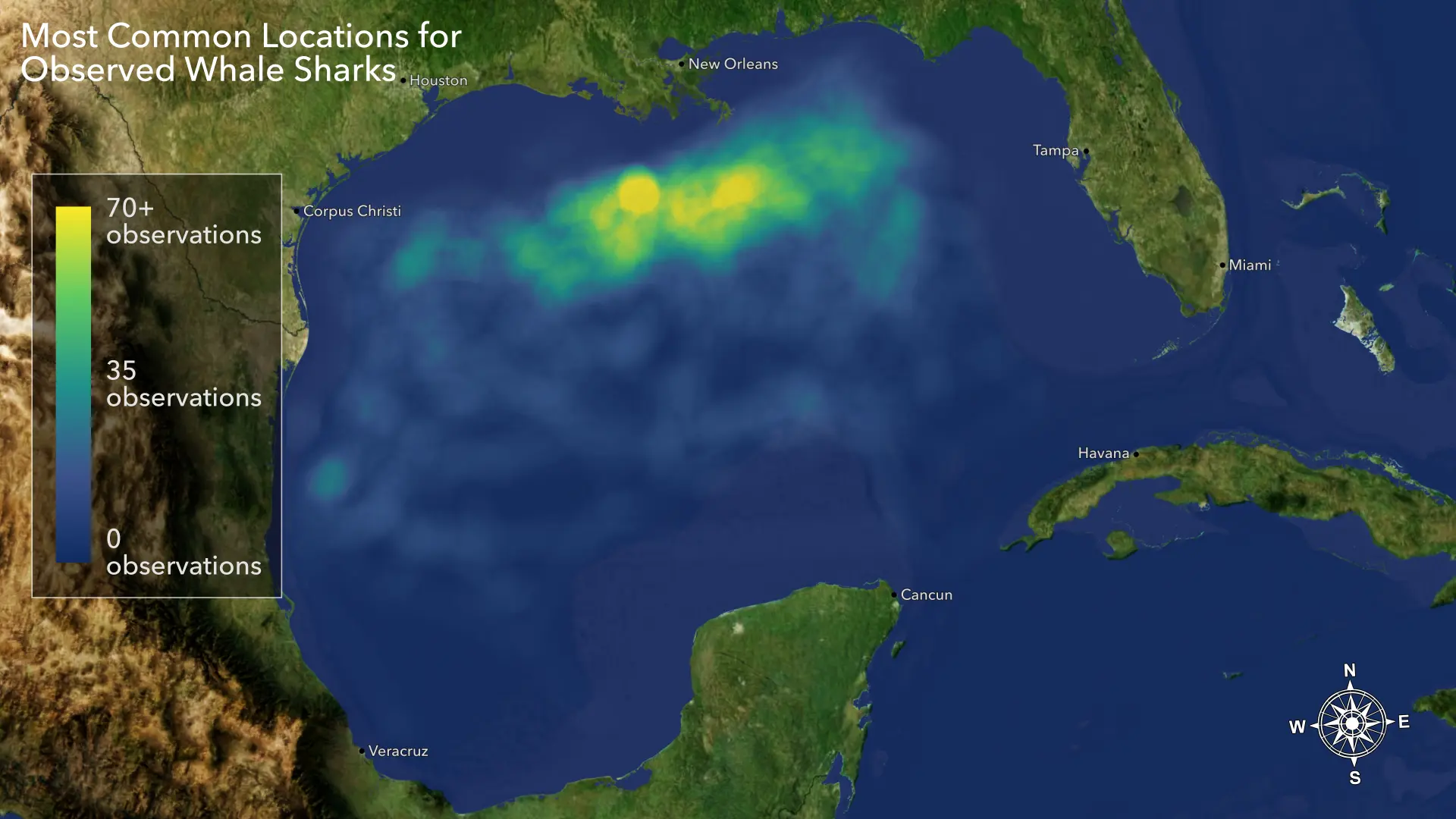
A color-coded ticker tracks the distance traveled by each shark. Many of the sharks stay close to coasts, particularly in areas where shallow waters transition to continental drop-offs and the deep ocean. Some of the sharks, though, transit the deep waters of the gulf before ending up near Cuba or the Yucatán Peninsula. A graphic at the end summarizes the parts of the gulf where the sharks were observed most often, creating a sort of whale shark heat map.

Map of the Gulf of Mexico showing where whale sharks were most commonly observed.
Bright yellows and greens highlight the parts of the gulf where these 15 sharks were observed most often. (Source: Maps.com)

The sharks observed in the map traveled an average of 4,600 kilometers (equal to the approximate width of the contiguous US), with one shark topping out at 11,100 kilometers. And although they travel immense distances, whale sharks are slow swimmers. At a speed of just five kilometers per hour, it takes some time for these gentle giants to cruise through Earth’s oceans.
More to Explore

  • Check out more maps showing migrations and movements of osprey, blue whales, and white storks.
  • Take a deep dive into more maps chronicling Earth’s oceans.

About This Map

Title
Whale Shark Movements in the Gulf of Mexico
Creator
Charlie Lott and Rich Spencer, Maps.com
Data Sources

Movebank

Original Map

This original map was created by the Maps.com team. It is available for you to use in accordance with our media use policy.

Tags
Animated Maps Historical Oceans Original
Share This Article

Keep Exploring

Map of global shark attacks reported in 1950.

Where Do Shark Attacks Happen Most Often?

May 22, 2025
Living Planet
Animated Maps Historical Oceans
Map of Pacific Ocean off the coast of North America showing blue whale observations.

What Is the Migration Range of Blue Whales?

June 24, 2024
Living Planet
Oceans
Map of southeastern US showing vessel traffic.

Mapping Vessel Traffic in US Waters

December 16, 2024
People & Patterns
Economy Historical Interactive
View More Maps
Next Post
Map of Japan showing August 2024 summer precipitation rates

Hot Nights and Rainy Days in Japan

March 6, 2025 Living Planet

Maps.com
Explore Today.
Create Tomorrow.
  • About Maps.com
  • Submit a Map
  • Contact
  • Legal
  • Privacy
  • Media Use
  • Manage Cookies
  • Do Not Share My Personal Information
  • Legal
  • Privacy
  • Media Use
  • Manage Cookies
  • Do Not Share My Personal Information
  • Categories
    • Living Planet
    • People & Patterns
    • Natural Wonders
    • Odds & Ends
    • Behind the Map
  • About
  • Submit Map
  • Contact Us
Subscribe

  • Legal
  • Privacy
  • Media Use
  • Manage Cookies
  • Do Not Share My Personal Information

Add New Playlist

  • Categories
    • Living Planet
    • People & Patterns
    • Natural Wonders
    • Odds & Ends
    • Behind the Map
  • About
  • Submit Map
  • Contact Us
Subscribe

  • Legal
  • Privacy
  • Media Use
  • Manage Cookies
  • Do Not Share My Personal Information

Thank you!

We have received your request and will send updates about Maps.com to your email:

Continue reading article

Sign Up For Updates

Skip to content