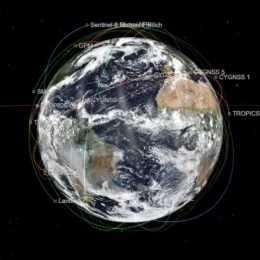
With more than 70 percent of its surface covered by water—and 99 percent of that being ocean—Earth is a water planet. And that water can reach depths exceeding 35,000 feet—about as deep beneath the waves as commercial airliners fly above them. Despite their mass and the amount of water involved, Earth’s oceans are still subject to the push and pull of external forces. These come primarily in the form of tides, which are caused by the Moon’s gravity pulling water towards it during orbit. The Sun, too, exerts a similar and much smaller force.
But not all tides are created equally. Due to the uniqueness of every shoreline, underwater features, and the shape of the seabed, tides can raise or lower sea levels just a few meters (6 feet) in some areas, to as much as 16 meters (52 feet) in others.
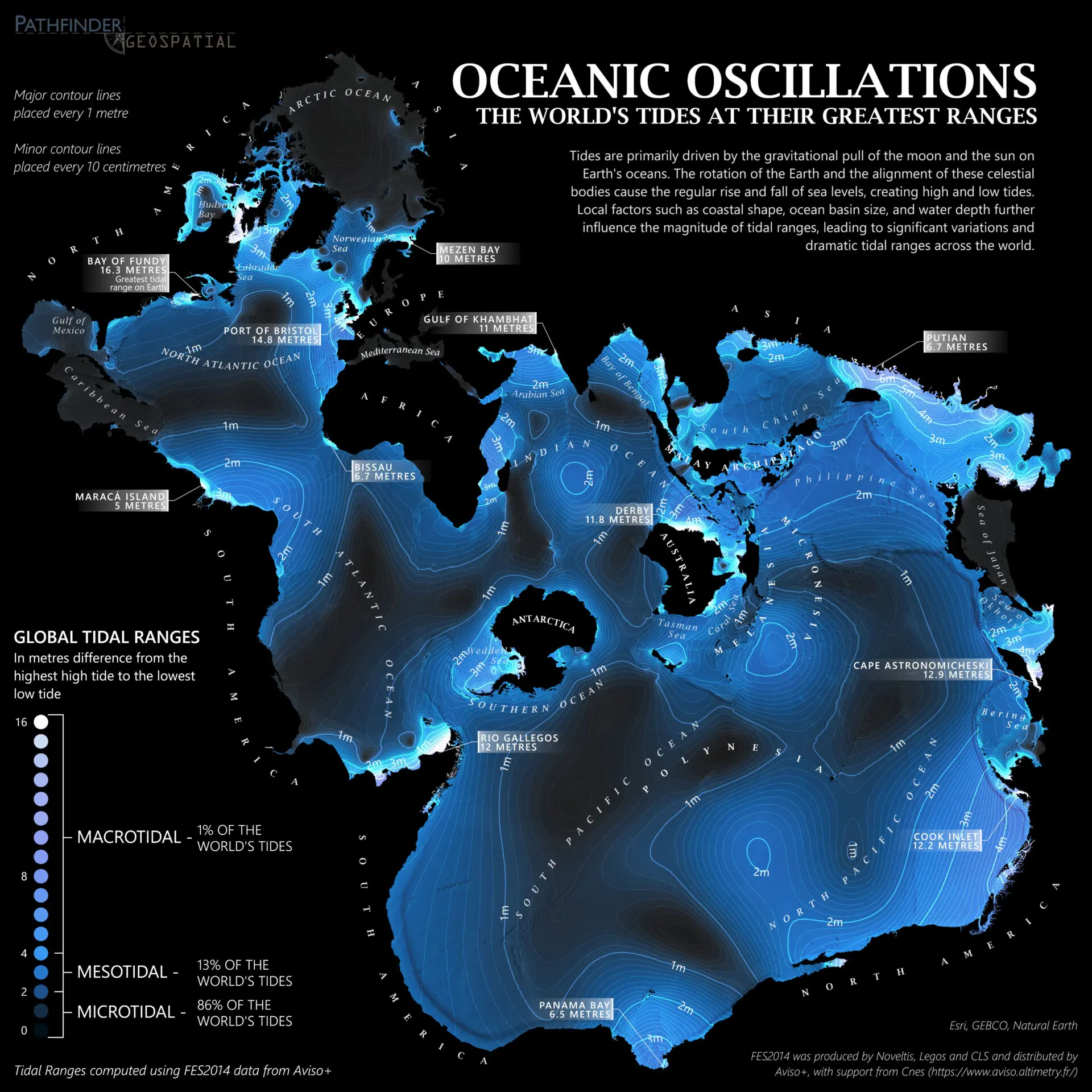
Dave Taylor, a cartographer and analyst with Pathfinder Geospatial, produced a stunning map showing the range and variety of Earth’s tides. While most tides fall in the microtidal category (less than or equal to two meters, or six feet), some areas experience tides nearly 10 times larger. Canada’s Bay of Fundy is home to the largest tides in the world, filling and emptying more than 100 billion tons of water with each cycle. That equates to more water than flows through all of Earth’s freshwater rivers each day. The tidal ranges for the map are computed from the Finite Element Solution (FES) tide model. Additional details come from the General Bathymetric Chart of the Oceans (GEBCO) and the Natural Earth project.
Several design choices make this map both attractive and effective. A vibrant yet colorblind-friendly palette shows the tide ranges intuitively, while contour lines reinforce the data and add precision. An eye-catching use of the Spilhaus map projection begs us to look closer as all Earth’s oceans are shown as a single, connected water body. Subtle relief gives clarity and character to the seafloor. Taylor also provides ample labels and annotations, highlighting key locations and providing explanations where necessary.
Like tides, the quality of maps also varies. And this map rises above most. It is as good for the eyes as it is for the brain, piquing both visual and intellectual interest in its subject.
About This Map
- Title
- Oceanic Oscillations
- Creator
- Dave Taylor
- Data Sources
-
FES, GEBCO, and Natural Earth
This map was contributed through the Maps.com submission program. If you’d like your map to be featured, submit it for consideration.
- Tags